
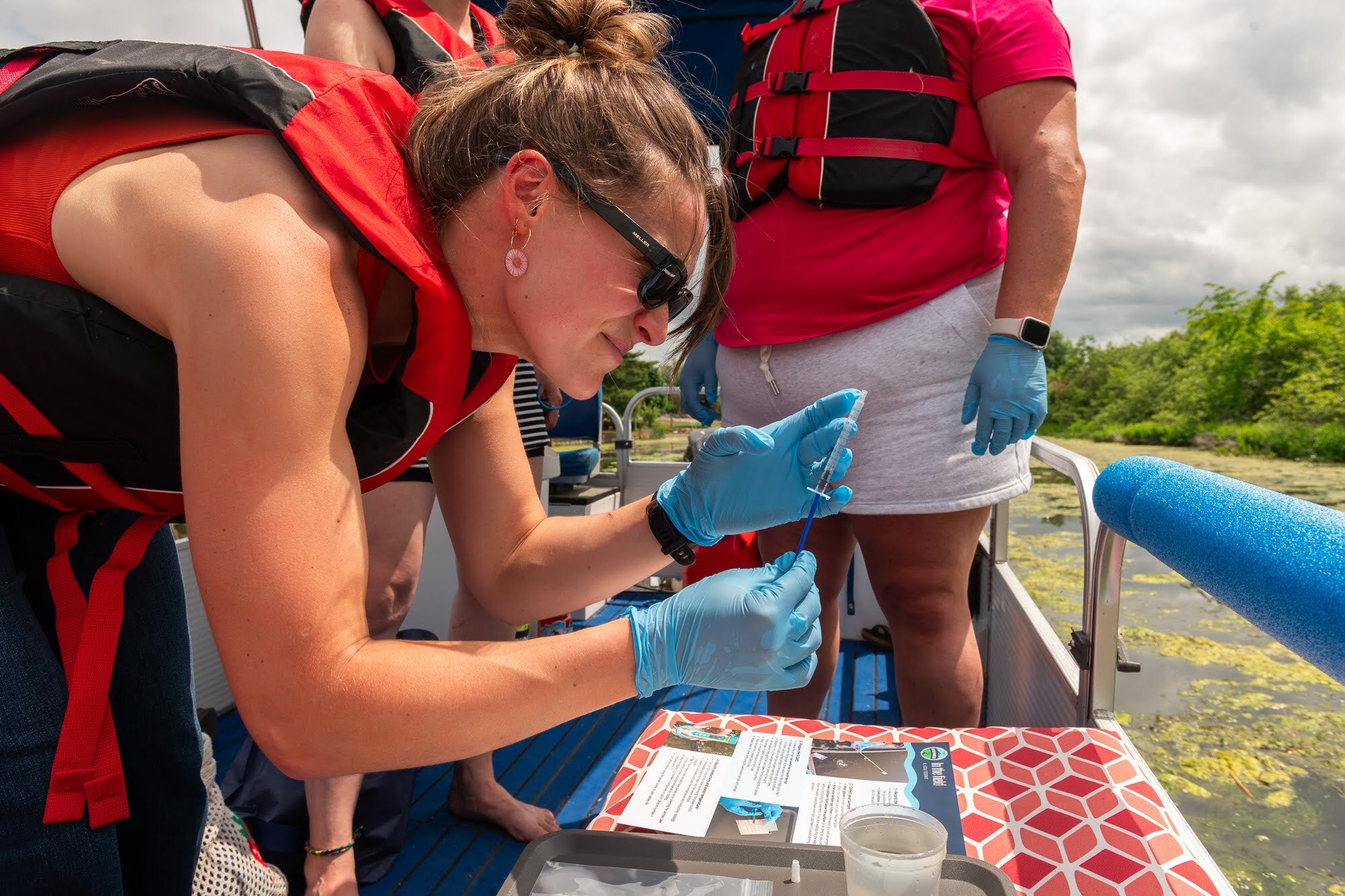
What is E.coli?
E. coli (Escherichia coli) is a bacteria and is in the fecal coliform subgroup. It lives in the intestines of warm-blooded mammals, including humans. While E.coli is healthy and naturally occurring, it can make us sick if we ingest it in our drinking waters or are exposed to it while swimming or engaging in other recreational water activities. E. coli plays a central role in measuring the health risks associated with sewage and contamination for natural water bodies, such as lakes, rivers, swimming holes, and marine beaches.
Why is E.coli important in recreational water monitoring?
E.coli is naturally occurring in our environment. E.coli is a reliable indicator of fecal contamination in our water bodies, namely from sewage. In other words, we can measure E.coli in water to understand if wastewater and stormwater have polluted a water body. E.coli is primarily used to monitor levels of fecal contamination in freshwater.
Water quality is like the weather. It can change quickly and frequently, so monitoring for E.coli and other fecal coliforms at the beach needs to be done frequently.
Guidelines for monitoring E.coli at beaches, rivers, lakes, and swimming holes were developed based on epidemiological evidence. This science relates the concentrations of these fecal coliform bacteria to the incidence of swimming-associated gastrointestinal illness, such as diarrhea, observed among swimmers.
How can we measure health risks at the beach using E.coli?
The concentration of E.coli in a water sample is typically measured per 100ml. Methods to measure E.coli include membrane filtration (CFU), multi-tube fermentation (MPN), and more rapid processing methods like qPCR methods.
In Canada, the federal government guidelines, Guidelines for Canadian Recreational Water Quality, for E.coli are the following:
E.coli Guidelines for Primary-Contact Recreation∗
- Geometric mean concentration (minimum 5 samples) ≤ 200 E. coli /100 mL
- Single sample maximum concentration ≤ 400 E. coli /100 mL
Countries, states, and provinces have their own standards and protocols, but most are very similar when it comes to quantifying E.coli at the beach.
E.coli sample collection and processing protocol
There are many sample collection and processing methods available for quantifying E.coli concentration in water. However, to date, most require a laboratory to process results.
The most common methods for measuring the concentration of E.coli in water bodies are :
- Membrane filtration
- Multi Tube fermentation, such as IDEXX Laboratories colilert methods.
- Quantitative Polymerase Chain Reaction (qPCR)
These are known as “persistent” methods, and they enumerate the number of E.coli in the samples. Results from these methods are available between 4 to 48 hours.
Models for predicting the concentration of E.coli at beaches and other recreational water sites are also used to forecast water quality. These models work just like weather forecasting does. Using historical water quality data, current and historical weather data, and other parameters such as geography and currents, the water quality can be forecasted. Predictive models are able to offer information to beachgoers about what is happening right now and can even forecast up to two days ahead.
Water Rangers testing protocol
In 2025, Water Rangers released an E.coli testkit, using the ROTH R-Card™ rapid test method. This approach allows volunteers to process samples at home using a small, cost-effective incubator and report their findings. The R-Cards provide a reliable indication of E. coli levels in the samples. Their affordability enables multiple tests to be conducted, helping to identify potential ‘points of interest’ before employing more precise testing methods.
How to test
Prepare
- Put on gloves
- Label each card with the date and location information and the number of each card (1-3)
- Fill out your survey for environmental and other parameters
- Lay out the R-Cards in the tray: make sure they are level
Sampling

- Rinse the sample cup 3 times
- Collect the sample 15cm below the surface, or as deep as possible without including sediment.
- Fill the syringe to the 1mL mark (tap out any air bubbles!).
- Gently lift the film and squirt water onto the card.
- Roll the film down onto the sample, allowing the water to spread into a circular pattern between the film and the card. The water should be within the area of the top film but doesn’t need to cover the entire area. DO NOT press the film down… allow it to spread.
- Repeat for each of the three cards for one location using the same sample.
- Allow the R-Cards to seal (1-2 minutes) then place into the bag and seal.
Incubate
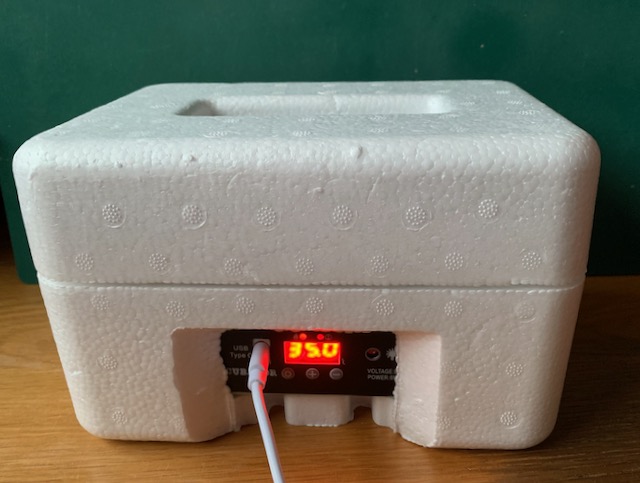
- Keep the cards out of direct sunlight and keep cool. Use a cool pack if it’s warm weather but DON’T put the cards on ice.
- Switch on the Incubator and allow it 20 minutes to warm up to 35 °C .
- Cards should be placed in the incubator within 3 hours of collection.
- The cards should be placed printed side up, and can be stacked on top of each other.
- Incubate the cards for 24 hours before counting the colonies.
Process
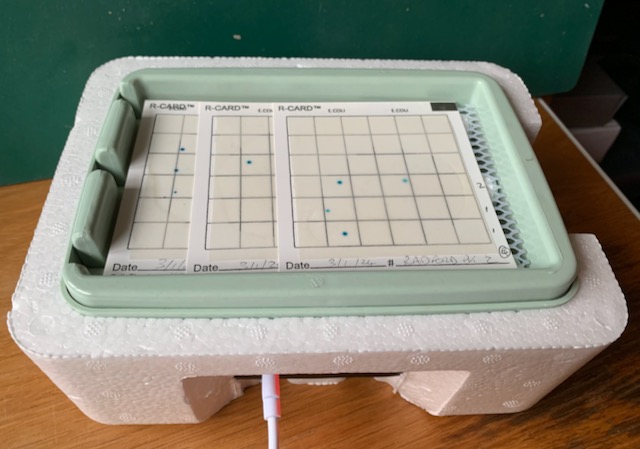
- Count the colonies (dots) on each of the cards
- Multiply the result by a conversion factor of either 100 or 33, depending on whether the 1mL or 3mL cards were used to report Colony Forming Units (CFU) per 100mL.
How-to video from Kentucky Watershed Watch
E. coli guidelines
In Canada, the federal government guidelines, Guidelines for Canadian Recreational Water Quality, for E.coli are the following:
E.coli Guidelines for Primary-Contact Recreation∗
- Geometric mean concentration (minimum 5 samples) ≤ 200 E. coli /100 mL
- Single sample maximum concentration ≤ 400 E. coli /100 mL
Countries, states, and provinces have their own standards and protocols, but most are very similar when it comes to quantifying E.coli at the beach.
The thresholds for E. coli in English bathing waters:
- Excellent: E. coli threshold is ≤500 Colony Forming Units per 100mL (CFU/100 mL)
- Good: E. coli threshold is ≤1000 CFU/100 mL
- Sufficient: E. coli threshold is ≤900 CFU/100 mL
- Poor: E. coli values are worse than the sufficient threshold
In Scotland the values are:
- Excellent: E. coli threshold is ≤250 CFU/100 mL
- Good: E. coli threshold is ≤500 CFU/100 mL